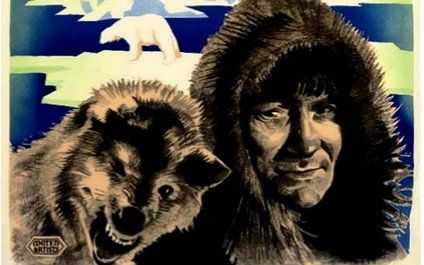
According to Fatimah Tobing Rony, the documentary Nanook of the North (Robert J. Flaherty, 1922) is an example of ethnographic taxidermy. Comparing the film subjects to taxidermies, Rony points out that the subjects’ images are discursively reconstructed. Challenging the film’s authenticity, Rony demonstrates the imbalanced power relationship inscribed in the documentary. Based on Rony’s writing, I will argue that Nanook of the North is an ethnographic taxidermy for it fulfills taxidermic impulse and distorts the subjects’ images, while the subjects also possess certain active power, which challenges the film’s taxidermic nature. In this essay, I will contend that the film’s subjects are taxidermized by being portrayed as dead, which promotes the sense of authenticity. I will then contend that the subjects’ images are abused by Orientalist ideologies and reconstructed as prototypical taxidermies the taxidermies. Dealing with the counter-point arguing for the authenticity of the documentary, I will deny the notion of participant observation and demonstrate the ways the film is fabricated. Seeing the taxidermic nature of Nanook of the North as questionable, the Inuit people’s acknowledgement and participation of the filmmaking will be examined. I will argue that they cannot merely be seen as taxidermies because the subject possesses potential subjectivity in reference to the notion of oppositional gaze.
In terms of the taxidermic nature of Nanook of the North, the subjects are portrayed as dead already. Like the lifeless taxidermies displayed in museum, the Eskimo are represented as prehistorical creatures, which makes their images appear more authentic. According to Rony, “In order to make a visual representation of indigenous peoples, one must believe that they are dying, as well as use artifice to make a picture which appears more true, more pure.”[1]To illustrate, André Bazin demonstrates an “obsession with realism” , while indexical forms as taxidermy and photography renders them powerful force as evidence.[2] Additionally, Mark Alvey highlights that the authenticity of taxidermy comes from people’s acknowledgement of its reconstitution, and therefore the notion of pastness becomes essential to indexical sign.[3] In the documentary, intertitles establish the camera and introduce the audiences to the world of the Eskimo. The filmmaker explains the Eskimo’s daily activities on their behalf, for the dead can no longer speak for themselves. Suggesting the impending death of the Inuit, the words such as “kill” and “hanger” are repeated in intertitles throughout the film. Moreover, the maps showing the geographic location of the native people’s inhabitant provides a sense of time travelling, implicating that they may no longer exist. As taxidermies, the Eskimos appear both real and dead, and thus their images become the most authentic and respond to people’s realist obsessions.
Moreover, the Inuit is represented as objects on display for their otherness based on the ideology of Orientalism. According to Rony, Flaherty reconstructs the Eskimo as naïve primitive lack of intelligence, while their images are consciously racialized based on popular imagination.[4] For example, Flaherty not only emphasizes the Eskimo’s behaviors of eating raw meat, but also compares them to animals by constantly intercutting between the Inuit and dogs. Having their lives shown as constituted by bloody huntings, the Eskimo appears wildly primitive and distinct from the civilized. Hence, the camera shares similarity with gun that they both offer thrilling experience by capturing the wild. In terms of Finis Dunaway, people temporally eschew from modernity and have their forbidden passion for wildness fulfilled through seeing the primitive.[5] Additionally, portraying the Eskimo in simple happiness, Flaherty’s subjects also appear lack of sophistication. It seems the primitive is only occupied by dietary concern, who remain a primal state without psychological requirement. Resembling the stuffed taxidermies, the Eskimo is portrayed only in surface level, whose inner world remain neglected. Not only being hunted by orientalist gaze, the Inuit are simultaneously captured by voyeuristic gaze. Revealing their half-naked bodies, the Inuit appears the most primitive without the awareness of shame. Highlighting their sexually connotative acts of “lick” and “touch”, Flaherty represents erotic images of the native that satisfy the audiences’ voyeuristic desire. Hence, as an example of ethnographic taxidermy, Nanook of the North offers an ideal prototype of the Inuit that conforms to orientalist gazes and the audiences’ expectations.
Nevertheless, Rony points out that the documentary’s authenticity has also been defended. It is commented by Siegfried Kracauer that Flaherty’s “slight narrative” resuscitates the indigenous people’s pure modes of existence, simply capturing their lives as authentic primitive.[6] Precisely, Flaherty’s long takes, deep focuses and self-effacing camera movements contribute to a realistic representation. Thus, the natural cinematography suggests participant observation and the audiences seemingly acquire perceptual freedom.[7] However, I would argue that it can merely be seen as an observation, while potential impositions of western values devalue the subjects as idealized taxidermies in the film. To illustrate, Rony demonstrates that the notion of participant observation suggests an encounter, which acknowledges the subject’s own perspectives. Instead, the natives are only represented from the observer’s vision, whose images are distorted by stereotypes. Furthermore, Rony argues that the indigenous are attached with Western values. For instance, the Eskimo seems living harmoniously in an idealized peace that free from war; In the hunting sequences, the native appears considerably preserved and brave, resembling the superhuman with unlimited strength. Additionally, the mother (Nyla) always devotes to her child (Allegoo) and the father appears independent. Embodying the idea of proper gender role, the Eskimo is represented in a traditional family corresponding to western value. Thus, it is highly contestable whether the Inuit see themselves in the same way. According to Rony, the Eskimo is portrayed as the “primitive protestant” with protestant value, which functions to comfort white people in terms of the Nordic’s fear of racial annihilation.[8] Incorporating the cherished traits of peacefulness, courage and nuclear family, Flaherty makes the Eskimo’s images acceptable to Western audiences. Therefore, the documentary represents the indigenous in the ways the viewers expect to see, crafting them as ideal taxidermies that attractive and satisfactory.
Additionally, the fictionality of the film is revealed according to the staged poses, the inaccurate depictions and the removal of history. In the trading sequence, the intertitle suggests that Nyla is showing her baby off to the trader, while she is actually facing the cameraman. As a staged pose, the Inuit baby is deliberately represented in to the audiences in a fabricated composition, which manifests the fictionality of narrative. Moreover, it is manifested that the Inuit people find the depictions of their ancestors in the documentary inaccurate. According to Jo-Anne Birnie Danzker, “Allakariallak’s clothing was not indigenous to the region; that the contrived sequences were highly amusing to the Inuit; that the seal hunt was contrived.”[9] Moreover, Rony contends that Flaherty removed the part of history regarding to the connection between the Inuit and the white people. Based on historical fact, the Inuit not only knew gramophones, but also adopted Western tools and clothes.[10] Selectively, Flaherty represents the indigenous as archetypal primitive, who are raw-meat eaters using only primal hunting tools and wearing animal furs. Consequently, the fictional production process of the film is suggestive of its taxidermic nature, while both the taxidermy and the documentary are creations of illusion of reality.
However, the film’s taxidermic quality is questionable due to the subjects’ awareness of being filmed. Participating in the filmmaking, the subjects may act out their real self-conception. Acknowledged by Rony, the Inuit collaborated to make the film, who act, repaired camera and washed exposed film, etc.[11] It appears to me a feeble argument that Rony denies the film’s collaborative nature due to the lack of existing Inuit accounts of the process. Although the extent of collaboration cannot be confirmed, I would argue that the Eskimo undoubtedly collaborated in performing themselves. According to Thomas Waugh, the people playing themselves would be the most expressive, who would act in specific ways based on their real characteristics.[12] Thus, although the subjects were told to act, it is possible that they naturally performed themselves out of authentic intuition. William Rothman argues that it is undoubtful that Allakariallak understands the film “is made to be view, that the camera filming him not only stands in for the visible filmmaker who is really in his presence, but also for viewers who are absent, invisible.”[13] In the igloo sequence, Allakariallak waves and grins at camera, who is possibly showing genuine happiness in his own approach. Therefore, unlike the dead taxidermies completely deprived of autonomy, the Inuit is aware of the camera and consent to perform without being forced to.
Noticeably, Nanook also stares at the camera, which suggests the notion of oppositional gaze. In terms of Paula Amas, “when people look back at or toward the camera—that purportedly has the effect of unbalancing cinema’s dominant gaze.”[14] Challenging the Orientalist gaze of the audiences, Allakariallak looks back at the camera as a refusal and a mock. Instead of performing himself as a simple happy man in accordance to the audiences’ expectation, it is manifested that Allakariallak merely found it funny being shot by a camera.[15] Irrespective of the Western audiences’ perceptions, Rony acknowledges that Allakariallak may be seen as laughing at the camera from the Inuit people’s perspectives.[16] Unconcerned by the onslaught of modernity, Allakariallak mocks the over-civilized at their nervousness by laughing at their camera. Moreover, in the walrus hunt sequence, Allakariallak’s direct gaze appears threatening and fierce, who is no longer amicable but views the camera as an intruder. According to Rothman, “he is not denying his relationship to the camera, but he is declaring that this relationship has a limit, that this limit must be respected.”[17] The oppositional gaze towards camera indicates the subject’s active power, while the filmmaker challenged by the gaze subsequently cuts to a view of the sea, respecting the subject’s refusal of being recorded. Consequently, the oppositional gaze further demonstrates the subject’s subjectivity in the documentary. Not merely being passively shot, the subject can challenge the filmmaker and orientate the way he becomes represented.
Conclusively, Nanook of the North is an example of ethnographic taxidermy in terms of its lack of authenticity and its ideological functions. Discursively portraying the subjects as dead, the documentary fulfills the audiences’ realist obsessions; Reconstructing the Inuit’s images in terms of orientalist stereotypes, Flaherty represents the subjects as prototypical taxidermies of the uncivilized primitive; Conforming to the audiences’ expectations, the idealized images of the native appear reassuring and satisfactory; Based on the staged poses, the inaccurate depictions and the deliberate removal of history, the production process also suggests the film’s artificiality. Acknowledging the subjects’ participation of the filmmaking, the taxidermic nature of the film is also contestable. In terms of the Inuit’s voluntary self-performance and the notion of oppositional gaze, it is possible that the subjects possess active power. Although the subjectivity of the subject can hardly be confirmed due to the lack of evidence, the availability of their authentic willfulness should be taken into consideration. Consequently, although the subjects are taxidermized in multiple aspects and the production process is highly fictional, it is reductive to consider the subjects as merely taxidermies in Nanook of the North.
Bibliography
Alvey, Mark. “The Cinema as Taxidermy: Carl Akeley and the Preservative Obsession.” Framework 48, no. 1 (2007):23–45.
Amad, Paula. “Visual Riposte: Looking Back at the Return of the Gaze as Postcolonial Theory’s Gift to Film Studies.” Cinema Journal 52, no. 3 (2013): 49-74
Bazin, André, and Hugh Gray. “The Ontology of the Photographic Image.” Film Quarterly 13, no. 4 (1960): 4-9.
Dunaway, Finis. “Hunting with the Camera: Nature Photography, Manliness, and Modern Memory, 1890-1930.” Journal of American Studies 34, no. 2 (2000): 207-230.
Geiger, Jeffrey. “Fiction, Truth, and the Documentary Contract.” In Film analysis: A Norton Reader, edited by Jeffrey Geiger and R. L. Rutsky, 94-114. New York: W. W. Norton & Company, 2013.
Rony, Fatimah Tobing. “Taxidermy and Romantic Ethnography: Robert Flaherty’s Nanook of the North.” In The Third Eye: Race, Cinema, and Ethnographic Spectacle, 91-126.Durham, N.C. and London: Duke University Press, 1996.
Rothman, William. “Nanook of the North.” In Documentary Film Classics, 1-20. Cambridge: Cambridge University Press, 1997.
Waugh, Thomas. “Acting to Play Oneself: Acting
in Documentary.” In The Right to Play Oneself: Looking Back on Documentary
Film, 71-92. Minneapolis and Minn: University of Minnesota, 2011.
 Film & Art